
3 easy RTI math intervention Strategies to use during your cgi math block
Do you have a set routine where kids are working on math story problems? In first grade, we do CGI math problem solving 3-4 times a week and it is the perfect time to naturally use some of my favorite RTI math intervention strategies!
CGI math problem solving
The wonderful thing about teaching in a CGI math classroom is that I get to see the way kids think. It’s a much more colorful and meaningful look at where my kids are. CGI gives me more information. Unlike the math workbook pages of the past where a teacher could say, “These kids get it and these kids don’t,” CGI math gives me an entire spectrum of thinking.
After each day of math, I can say, “These kids solved using relational thinking, these kids still had to count on to add, these kids had to draw a picture to solve the problem, and these kids….
Still. Don’t. Get. It…
So if you are like me and constantly looking for some fresh ideas and math intervention strategies for RTI math, here’s a look at how I used small groups as math intervention in my CGI classroom for my struggling learners.
Launching the Math Problem
A true CGI classroom is the perfect place, in my opinion, for struggling learners. First of all, after launching the problem, I have my firsties show me with their thumbs how well they are understanding the story problem…

After I launch the CGI problem, my babies who don’t understand the problem type always choose to stay with me on the carpet by showing me thumbs down (and if they don’t choose to stay and should have, I choose for them! *wink*) so we can act out the story together. They don’t leave to solve independently until we have solved one together. There’s my first 5-10 minutes of math intervention strategies for RTI babies.
CGI Conferencing
During conferencing, I have a set group of kiddos I conference with first. At the beginning of the year, after doing 3 or 4 CGI problems, I sort kids into 3 basic piles: low, medium, high based on my expectations. Then I mix the kids into 3 groups of 8 kiddos each. The groups have close to equal numbers of high, medium and low babies. Then I record them on a notecard in a color coded system (see pic below) and that is my guide for conferences.
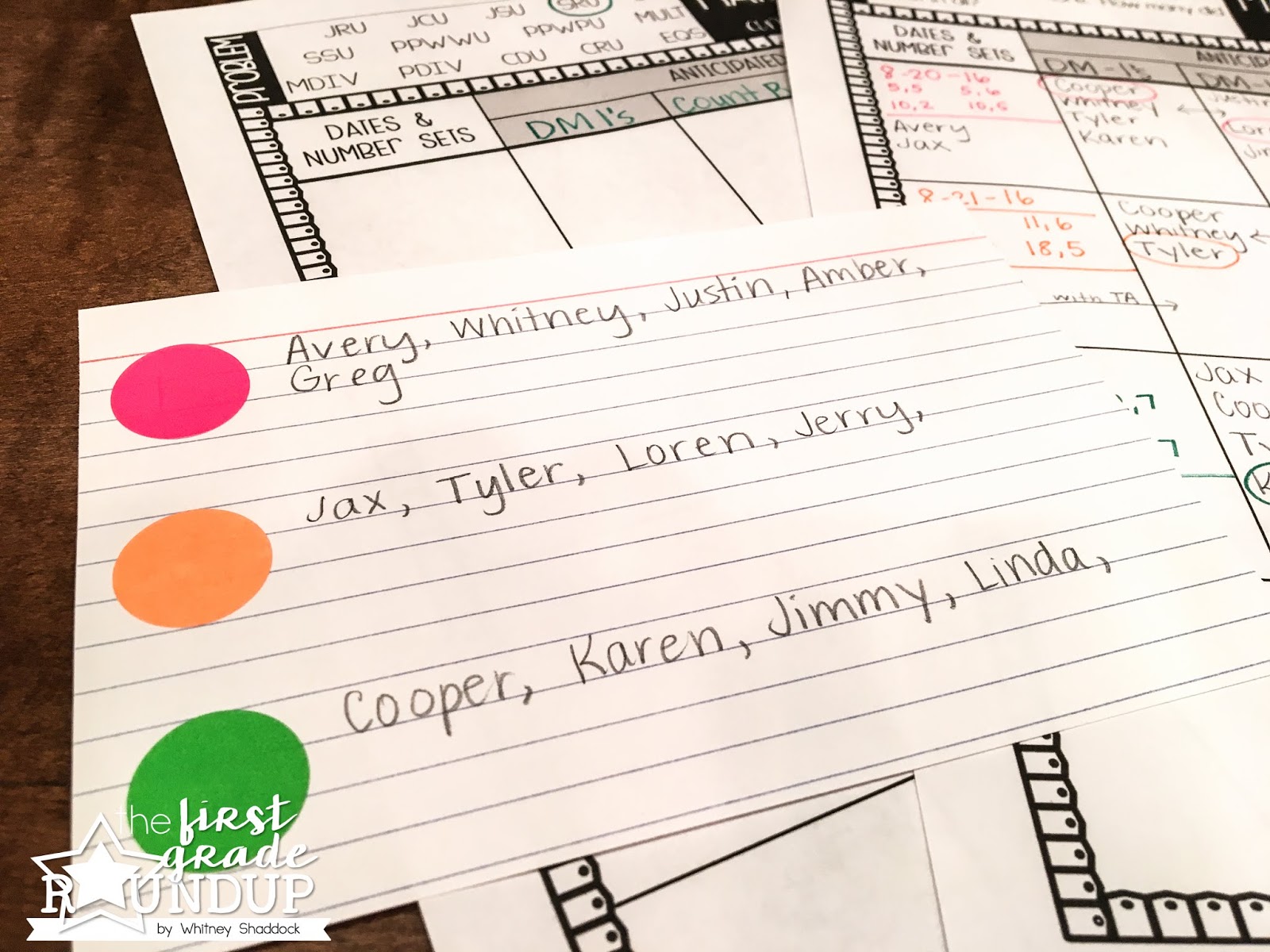
Generally, I rotate groups–first I meet with my pink, then orange, then green. But in reality, I rotate it by problem type. You can see on the picture above where I’ve written in the margins what color I conferenced with that day. This is for my own sanity!!!
Since I mix up problem types and don’t usually do the same problem type for several days in a row, I record who I met with so that the next time we do that problem type, I know who I need to conference with. I know that’s a lot to process, but, yes, that does mean that every now and then I conference with the same color two days in a row because we’re doing 2 different problem types, but generally it works. You could do it however works best for you…the important thing is spreading your conference love around! 🙂
The reason I do a mixed ability of groups is for time management: If I meet with all lows on one day, I would never get them all done because the conference is so much longer. If I meet with all highs in one day, I’d be done in 5 seconds (well, not quite that, but you get the idea.) So I mix it up and it seems to be the right amount of time for me to meet with 8-12 kiddos a day.
If I finish the 8 in my color group early, I just choose who I feel needs me the most that day by observation and do some additional conferencing. 8 kids scheduled to conference a day means I conference with 2-3 of my low babies…that’s another 5 minutes of 1-on-1 intervention time if you counting it up!
Now let’s look at my records sheet a little more closely again. Notice that I do one page per problem type so I can be more specific with my math intervention strategies. Also, just because a kid solves one problem type one way, doesn’t mean he will with another problem! It’s just my personal preference to look at it like this!
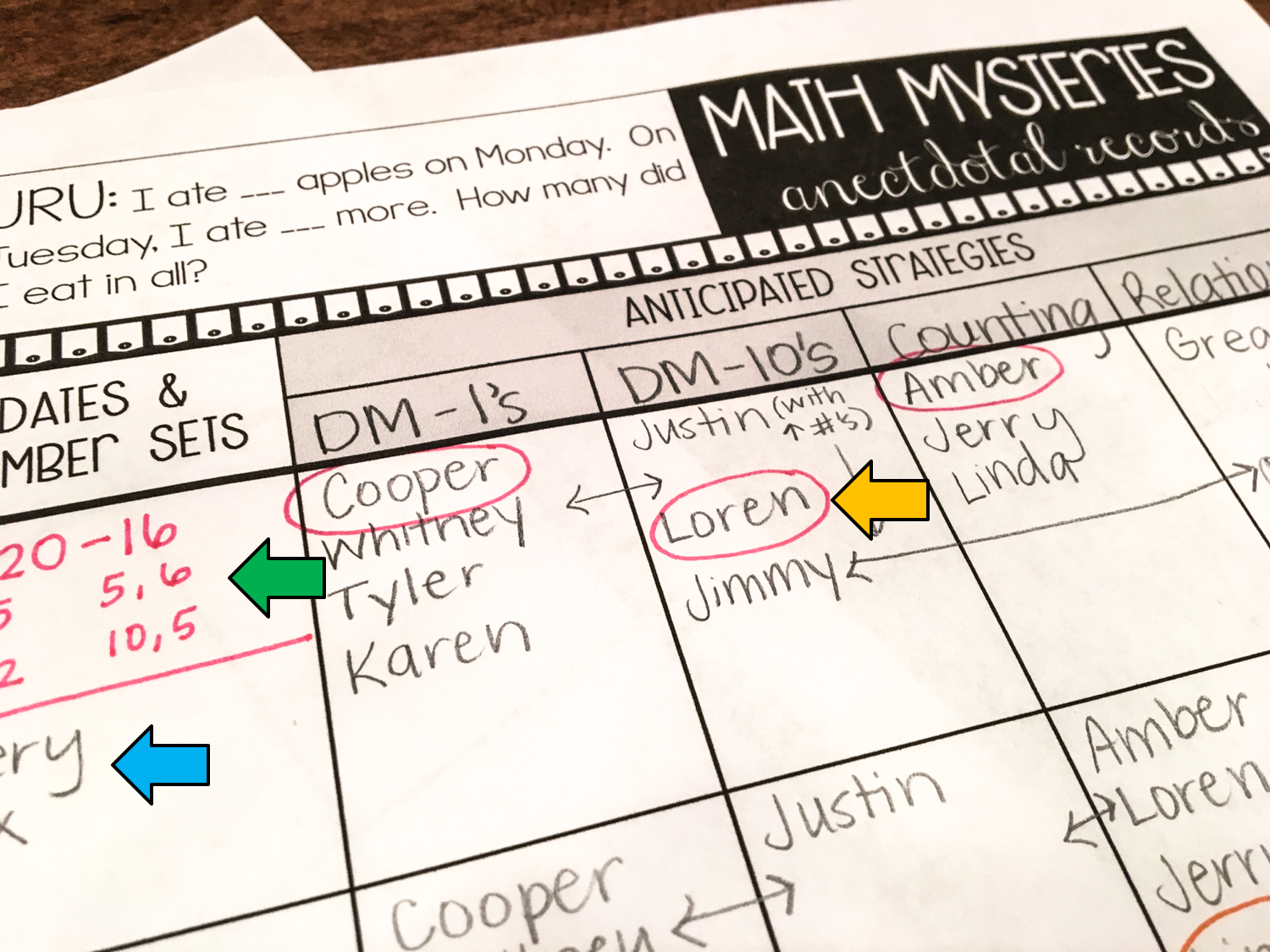
Green Arrow>>>Date and number sets most kids are working with (Sometimes I lower numbers for my strugglers and I always have 2 sets of 4 extension number sets on the board for my early finishers. The extension sets are color coded so that when they finish early, I can look at their work and tell them which color they need to work on based on their work…of course I can also give them their own set if I need to do that!
Blue Arrow>>>These are my strugglers. Their names are recorded under the number sets. I use this to pull intervention groups throughout the week during Fact Fluency time {which I’ll blog more about later}. After our intervention, I highlight kids who I felt were “good to go” so I could keep track of who still needed more math intervention strategies for a certain problem type.
Orange Arrow>>>Notice that 2-3 names are circled on each row. These are my sharers for the day. This is just to help my feeble mind remember who shared so that I don’t have repeat sharers multiple days in a row! 🙂 Also, it helps me visualize during share time who my target kids are for questioning. For example, Student “E” on my first row shared his counting strategy, so I knew by my chart that the students in my direct modeling box would be my focus kids for share time.
CGI Share Time
During share time, they get to learn from their peers. They get to listen to successful strategies from peers over and over and over. They get to watch friends act out problem-solving. And as long as I am asking my strugglers specific questions throughout share time and one-on-one conferencing, they stay focused and engaged…well, most of the time! #thestruggleisreal #justbeinghonest
If you’ve been tracking my time, that’s 10-15 minutes of small group or 1-on-1 RTI intervention with my lowest babies every single time I do CGI. That adds up to 40 minutes to an hour a week. Every little bit counts, right? What I love about using CGI math and RTI together is that it’s meaningful for the kids. It’s best practice, and RTI is just woven into it. CGI just naturally lends itself to math intervention strategies. I am the interventionist. I’m meeting my kids where they are and “growing from there!”
Thank you so much for this!!! I used your math mysteries this past year, but I tried to meet a little with every child every day and it was very stressful! This makes a lot more sense! I can't wait to read your other posts!
You're welcome. Meeting with every kid everyday?? Girl, you must have gone crazy!! 🙂 I did that a few times my first year before I gave up and worked out my system!
One more question, I promise. Looking at this new schedule, it looks like you will be doing math mysteries four days a week? How long will you spend on fact fluency and math games? I only have a one hour block for math so it is hard for me to get everything in. Thank you so much for your help!
Angie