
engaging earthquake science experiment for 2nd grade
Let’s talk EARTHQUAKES today! I’m just a southern gal who’s lived in Arkansas all my life, so I don’t have much experience with earthquakes.
Whether you live far away from earthquakes, or they are a little too close to home, Earthquake Science Experiments are important for all kids to know how they world works and how landforms can be created.

In the last few years, we have actually had some very small earthquakes. Like so small that I don’t even know they have happened until I see everyone’s “Whoah, what the heck was that?” posts on Facebook!
And, actually, the last one I did feel some vibrations, but didn’t realize it was actually an earthquake until my husband came home from work.
So, I truly don’t know what it’s like to have to build a house that will sustain an earthquake. And I’m super grateful for that. My heart goes out to people across the country and around the world when earthquakes destroy their homes and towns. The very least we can do is help our kids know and understand a little more about earthquakes, how they work, and how we can prevent severe destruction from earthquakes.
Let’s chat about an earthquake science experiment that will help your kids understand the mechanics of earthquakes, learn how to minimize earthquake damage, and build empathy for those who live close to earthquake zones.
Earthquake science experiment materials
Here is what you need for this simple earthquake science experiment.
Wooden blocks
Legos
Cookie Sheet

If you are like me and don’t have a ton of wooden blocks, this can easily be set up as a station. I always have a science and social studies station during my reading groups and literacy stations that integrates reading or writing into science or social studies. For second graders, this lab would be super easy to use for a center because it doesn’t take a lot of adult help. The directions are straight forward and there is no spill risk to have to oversee!
If you are lucky enough to have plenty of wooden blocks and cookie sheets to go around, then it will work well for everyone to do it together during your science block.
And it really doesn’t take a ton of blocks. A dozen of each type–wooden blocks and legos–will work just fine! And bonus… fewer blocks means a faster and easier clean up! #winning
earthquake science lab steps
First, we built a house out of wooden blocks on the cookie sheet that we thought would be able to survive the earthquake.
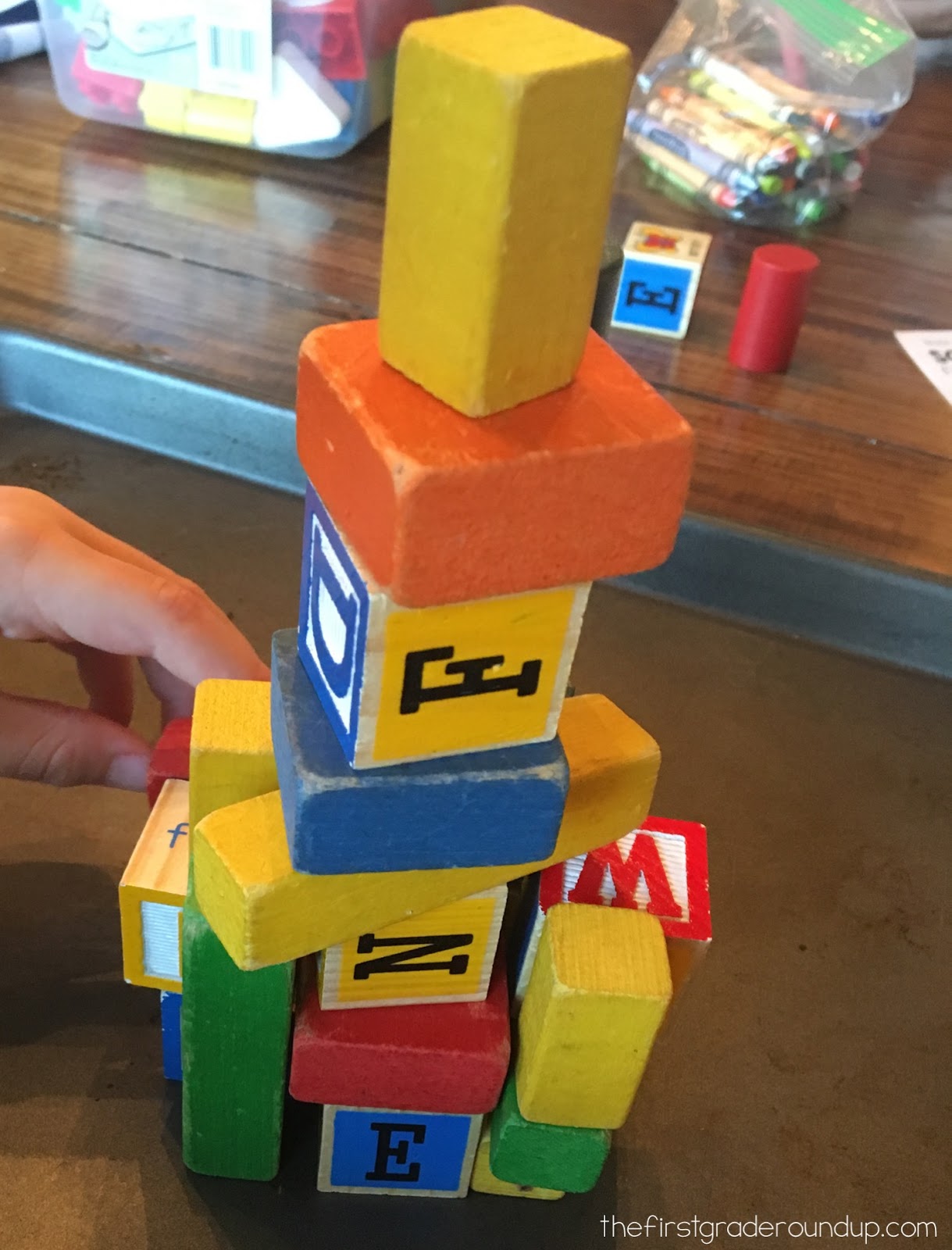
NOTE: It’s clear from the structures my son created that he’s five…and doesn’t completely understand physics yet, LOL!
Then, we made predictions to answer the question, “What will happen when we shake the wooden block structure?” My five year old’s prediction was, “STA!” 🙂
Then it was time to make an earthquake. You can have them shake the cookie sheet back and forth and observe the effects. When we did this, we created a weak earthquake by shaking the sheet slowly. And then we made a stronger earthquake by shaking faster.
And thanks to my hubby for the background music…he’s the one in our family always finding just the perfect songs to play in the background during our projects and this one would be perfect in the classroom with this experiment! 🙂
Then, we recorded our observations and made a conclusion about why the building did not survive.

Next, we did the same thing with a lego house structure.

Cue the music… #jumptheline
Finally, we evaluated which structure was the safest and why?

This is also what happens when you give a five year old a second grade experiment! A lego house is a dream house. #simplethoughts

You can grab this earthquake science experiment along with the entire Landforms unit here.


Hi! I'm trying to get the science lab handout, but I don't see the link to click. Can you please send it to me?
Hello. I would love to now where to get a free copy of this science sheet. Thank you!