
3 Easy tips for reading groups organization
Thanks to the science of reading, shifting from guided reading to data driven reading groups is a big shift. As I blogged about earlier, the planning can be easier, but the reading groups organization for yourself, your students, and your parents is key. Unorganized, last minute planning means it takes me twice as long to figure out what in the world I need to be doing!
Let’s chat about how my reading groups organization for my teacher space, my students, and my parents for data driven reading groups.

{this post contains affiliate links}
This is my Small Group Intervention area in my room. I love having my table in front of my cabinet area because it makes for an easy place to organize all of my texts and materials for decodable groups and reading skill groups.

Organizing the Teacher
After assessing my kids’ reading skills, I sort them by need. You can read all the details in this post on reading groups organization for my skill groups.
I have a laminated manila folder to sort my kids who need work reading decodable texts or my advanced kids that need work reading higher level texts. I write each kid’s name on a sticky note so I can easily move them from one group to another.
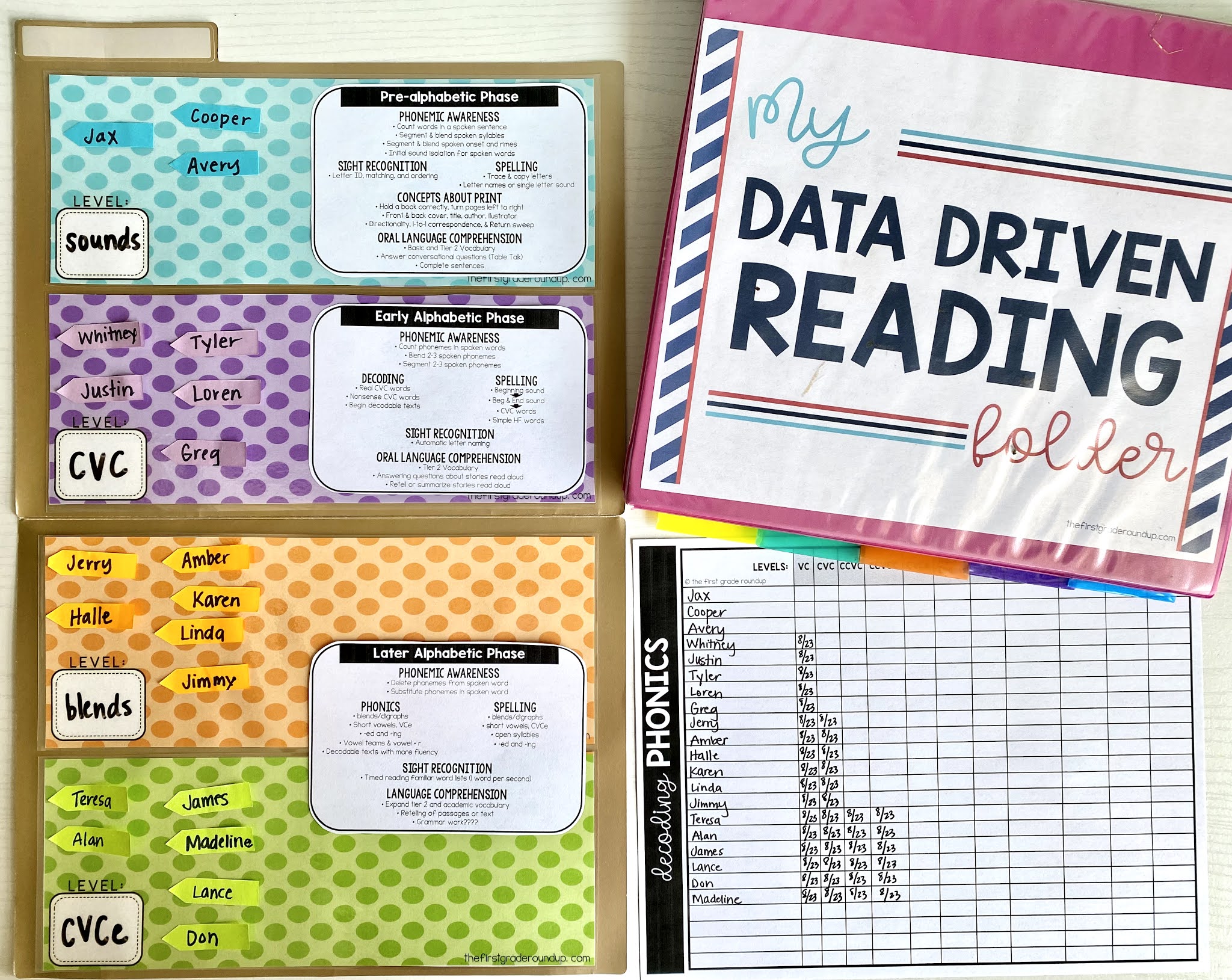
Each color represents a group: blue-purple-orange-green-yellow, with blue being the neediest group (usually the lowest level, but not always!) and yellow being the most advanced group. I try to keep my reading groups in a 6 or smaller group. My skill groups can go bigger if needed, but when reading a text, it’s helpful to have them smaller if possible, so I can have time to listen to each individual read.
If I have “outliers” or one or two kids in a decoding level alone, I put those to the side.
When my team is finished testing, we sit together and try to place outliers. So, if I only have 3 kids working on letter sounds and word decoding, that means I have 2-3 open spots for another teammate’s sounds outliers. I will add my colleagues’ kids to my group to make a full sound decoding group. And someone on my team will have a spot in their group to take my outliers too.
THIS IS SO HUGE that my team does this!! It keeps each of us from having too many groups and being overwhelmed. And I’m not giving them my “outlier” kid for the entire year, just until I retest…or until they show enough growth to move up early to another level.
I also have a 3-ring binder for keeping plans and running records in.
I bought plastic color dividers with pockets for my reading groups organization. The colored dividers coordinate with my colored groups, so my blue group has a blue divider, etc…{I like to color code just a little bit, can ya tell?}

In the front of my binder, I keep my data sheets and my weekly lesson plans.

{In my Reading Groups Organization Packet, I have a few options for the planning pages since we all think about this differently!}
In each divider pocket I keep decodable texts I’ll be using for each group plus index cards for recording reading records. These index cards are not only great data for how my kids are progressing, but they are also good for keeping track of which books kids have read and taken home.
I always highlight book titles on my cards when a student returns a book to school so I know if I can send another book home {I try not to send books home if they haven’t returned a book…:)}

Yes, I do running records every single time I read with a group. Religiously. More on that later.
When a card is full, I file it away under that student’s class number and keep them for the remainder of the year.

I store my decodable readers and passages in these plastic crates and they are sorted by decoding skill.

{You can grab the labels shown in my Small Group Reading Packet.}
All of the decodable texts or any materials like these that I need for my reading skill groups are kept in the cabinets and drawers behind my table so I can easily access them.


Organizing the Students:
I purchased these chair covers a few years ago and just sewed on some ribbon to customize them for my room! This is where we keep a dry erase board, abc and blends charts and a sock eraser and dry erase marker for our skill work.

This system is very easy for the kids to use and saves a ton of time! As a teeny tiny side note…each chair has the same color marker so they don’t waist time fighting over seats or colors! 🙂 {Every single second is precious, right??}
At the beginning of the year, students get library folders with their library barcode and we use these as our reading progress folders also! When I first test them, I staple in their reading level graph. This is what the first grade one looks like for the girls.
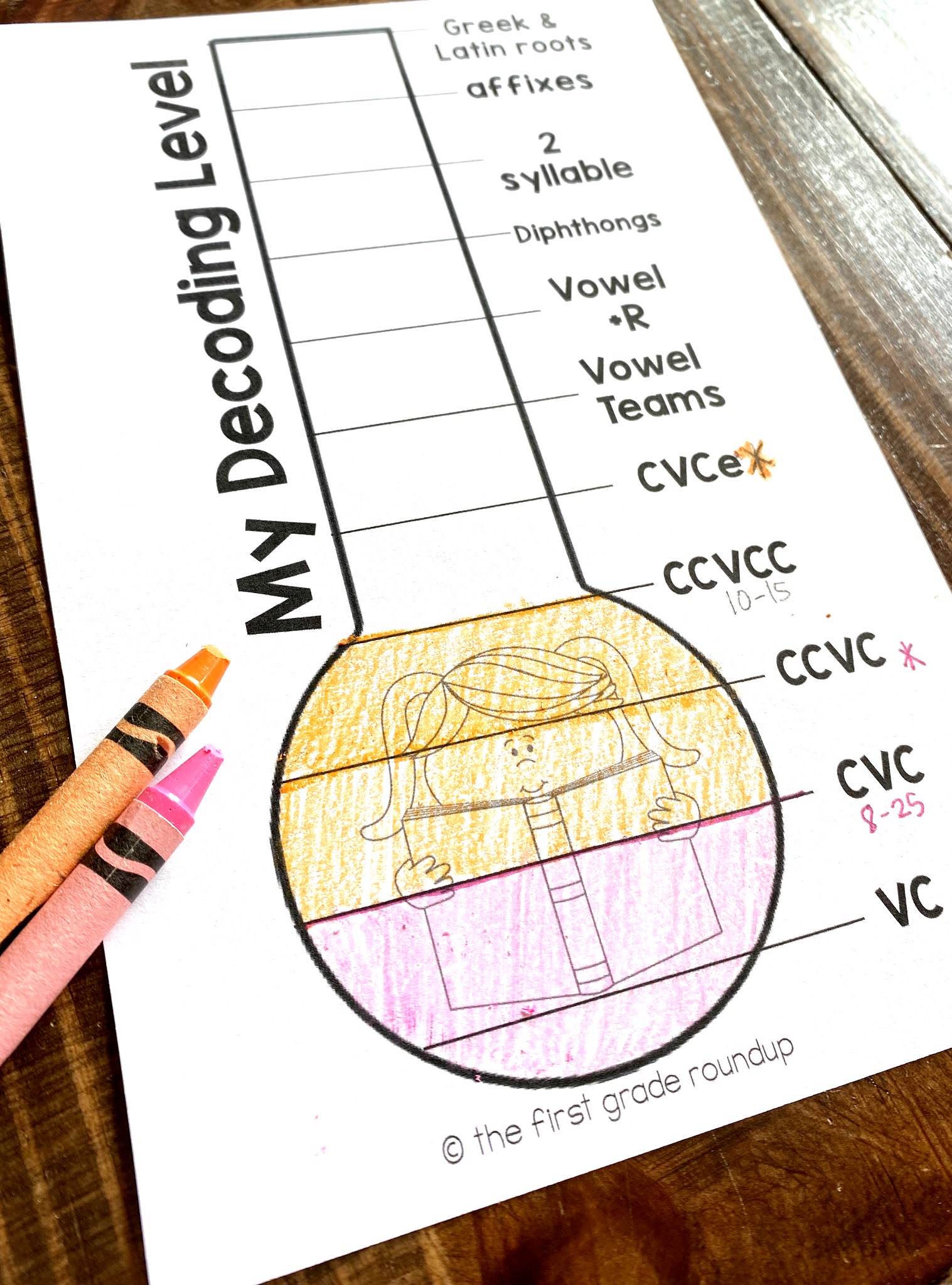
When I finish testing them, we color in their graph for the level they tested on and we discuss what their goal will be for the next time I test them. I’ve used this for a few years now and it is a really powerful visual for the kids. I tell them all that it is a private graph and they can share if they want to, but it’s not for bragging! 🙂
We also fill out a goal setting sheet and keep that stapled in their folder as well.


I am new to guided reading groups. I noticed that you meet with two groups daily. How long do you meet with each group?