
how to use kid-friendly informative writing rubrics to teach kids to self-assess
I love getting first grade kids involved in checking their writing. Using kid-friendly informative writing rubrics is the perfect way to do this. Good writers must be able to find and fix their own mistakes in their writing. Teaching kids to self-assess their writing or any work early on will help them become better writers and students!
Let’s take a peek at our informative writing rubrics we use for self-assessment in first grade.

Choose a Focus Area
Now that we are getting ready to write research papers on specific animals for our animals unit, we have been looking closely at our informative writing rubric.
But the entire rubric can feel overwhelming. Especially in the beginning. So we break it down into four focus rubrics for each of the four areas of the rubric. This makes using a rubric more accessible to first graders. And by the end of the unit, they will be able to use the entire rubric and see how the four individual sections fit together to make one informative writing rubric!
Each week, we focus on one of the four areas of our informative writing rubric: content (or paragraph structure), sentence formation, language, and mechanics. We use the rubric for the focus category during our share time to assess each other’s work.

This rubric looks exactly like the matching section in the larger rubrics, but it just has the one category so that it’s more kid-friendly and less overwhelming. It also helps to keep our focus on the skill we are working on for that writing lesson.
Self-Assessing With An Informative Writing Rubric
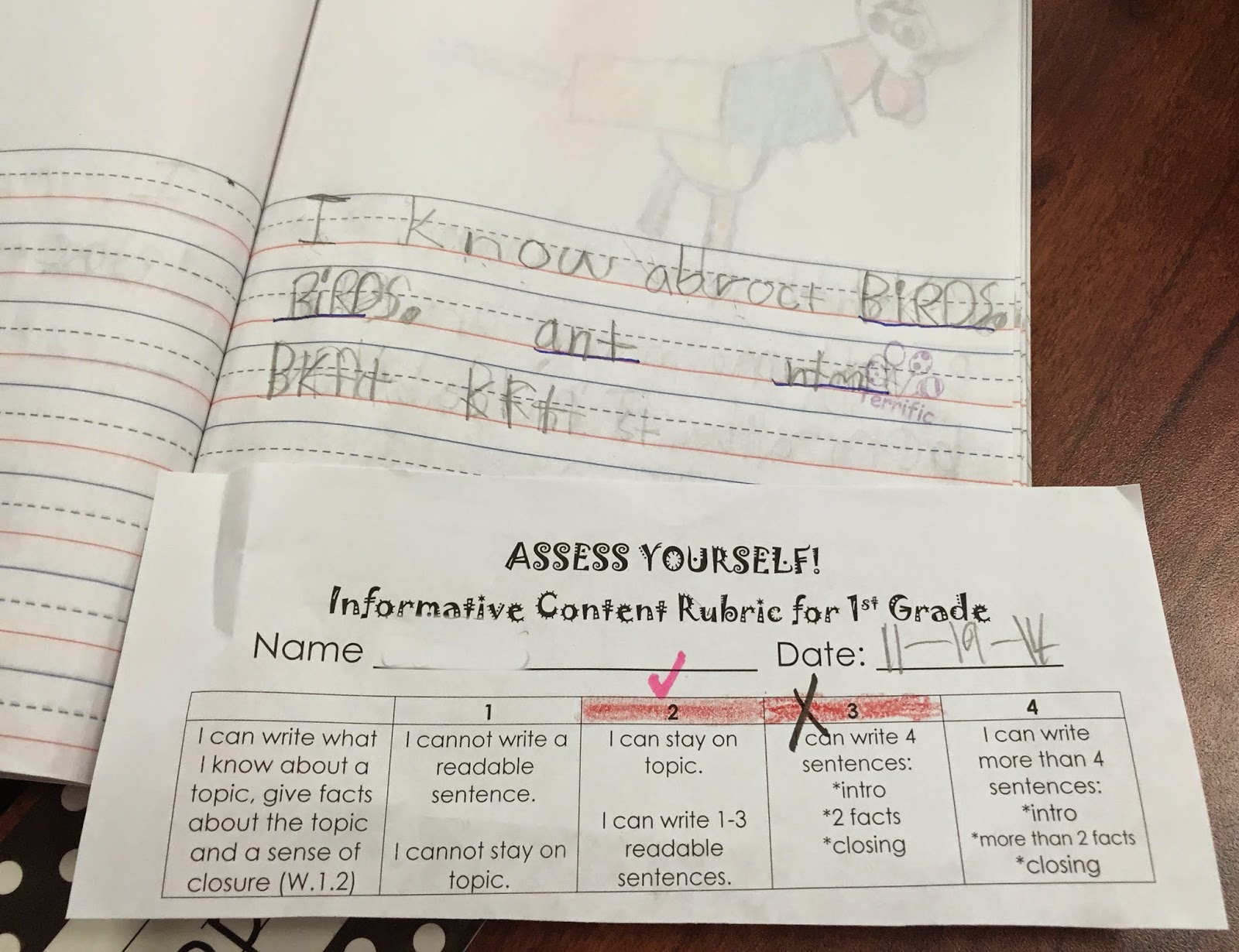
Once a week, my firsties are self-assessing their own writing using the same category rubrics. We will do this in place of our share time and I will walk around and check in on their self-assessment. You can see my pink highlighter checks below where I went around to tell each kid whether or not I agreed with their scores, just for some extra accountability.


Teacher Conferencing
When students are finished self-assessing their writing, they bring it to me to check. I check through it with them talking aloud as I go. For example, “You stayed on topic. And you wrote readable sentences, but I only count 2 sentences. So you have a level 2 writing, not a level 3 writing.”
I want to give them some accountability with their assessing so they arent just choosing 3 or 4 and being done. I want to help kids be able to prove or defend why they scored themselves a certain way. And for those kids who give themselves a better score than they should have, it’s a great opportunity to talk to them one-on-one about specific things and goals they can set to move their writing forward.
…and just so you realize that not all of my writers are where they need to be….here’s a little reality check for you! We all have these special babies that need extra care, don’t we??
But ya know what? When I double checked this sweetie’s writing with him, he had already changed his score from a 3 to a 2 AND he could tell me what he needed to do to get a 3 {“I write more!”} I don’t know about ya’ll, but I call that a BIG WIN in my book!
Sometimes, instead of a self-checking time, we do a peer editing and checking time where they work together to help a partner check their writing. I like to switch it up and not always assess on their own or always with a peer!
You can grab my self-assessing writing rubrics for kindergarten, 1st grade and 2nd grade HERE!

Your classroom looks so cheery! Cute Christmas tree. I really like the way you use your rubric to have the kids self-assess and then use your highlighter to indicate whether you agree. Thanks for sharing!
Jan
Laughter and Consistency